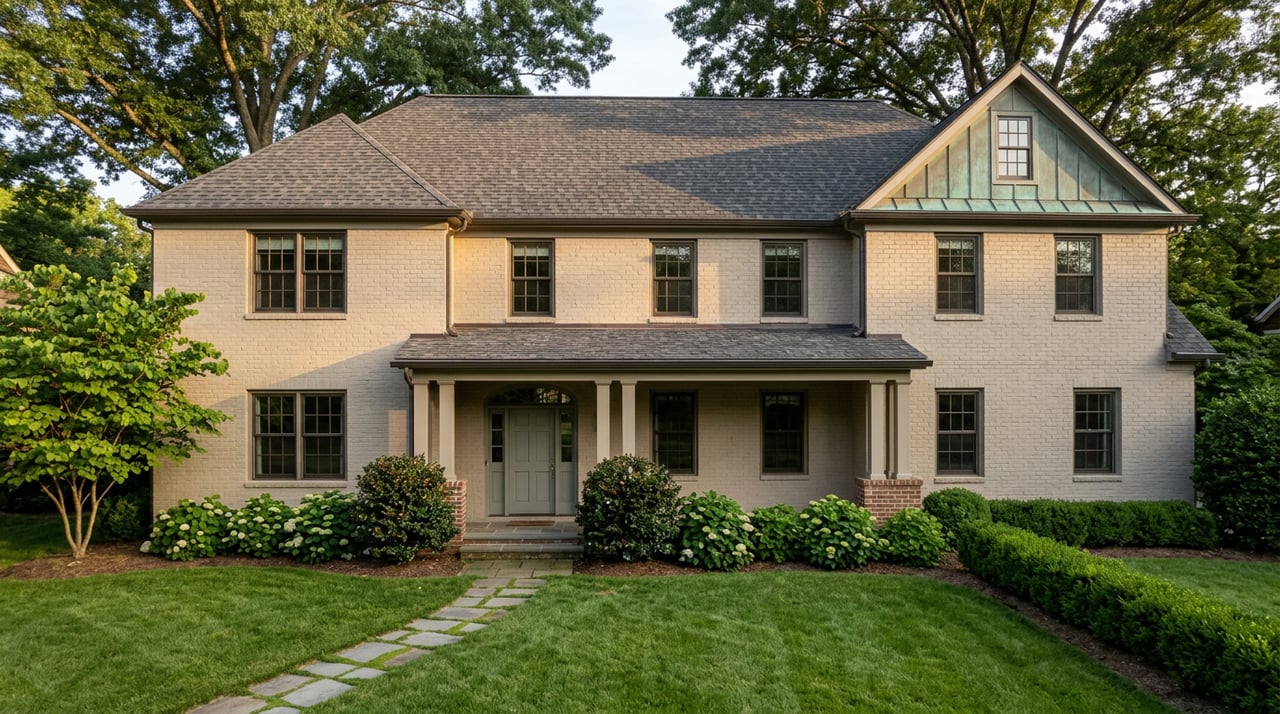
If you own a home inside Roswell's Historic District and you just got your Certificate of Appropriateness approved, can you call your contractor and start work Monday morning?
Most owners assume yes. The Certificate of Appropriateness, or COA, feels like the finish line: you presented your plans, the commission signed off, the hard part is over. But the COA governs one thing only, the visible appearance of your property. It says nothing about whether your framing meets code, whether your electrical panel can carry the new load, or whether your contractor is even allowed to break ground yet. That's a separate review, on a separate clock, run by a different part of the same building. Roswell's own zoning ordinance is explicit about the sequence: no land disturbance permit or building permit can be issued without an approved Certificate of Appropriateness already on file for the property. The COA doesn't replace the permit process. It sits in front of it, like a gate you have to pass through before the next gate even opens.
For anyone planning a renovation, or preparing to list a historic-district home this fall, that sequencing is the detail that actually determines your timeline, not the design itself.
The Conference Before the Application
You don't walk into Roswell's Community Development Department and file a COA application cold. The ordinance requires a pre-application conference with the Zoning Director first, where staff reviews your proposal and makes an initial call on how it will be classified. That classification determines everything downstream: which office signs off, whether the public gets a say, and how long you should realistically expect to wait.
This step catches people off guard because it's easy to treat it as a formality, a quick phone call before the "real" application. It isn't. It's the moment your project gets sorted into one of two entirely different review tracks.
Minor or Major, and Who Signs Off
| Minor Certificate of Appropriateness | Major Certificate of Appropriateness | |
|---|---|---|
| Who approves it | Zoning Director | Historic Preservation Commission |
| Public hearing required | No | Yes |
| Typical scope | Smaller, more routine exterior changes | Larger or more visible alterations |
| How you find out which one applies | Pre-application conference | Pre-application conference |
The practical consequence is that two homeowners on the same street, doing what feels like similar work, can end up on completely different timelines. One gets an administrative sign-off in days. The other waits for an open slot on the Historic Preservation Commission's regular meeting calendar, and has to present the project in a hearing where neighbors can weigh in. If you're coordinating a renovation around a contractor's availability, or trying to have a home listing-ready by a specific date, knowing which track you're on before you sign a contractor agreement is not optional information. It's the whole schedule.
What the Commission Doesn't Regulate
Here's the part that surprises even longtime owners: the Historic Preservation Commission has no authority over exterior paint color. A 2014 opinion from the Georgia Attorney General's office settled this directly, confirming that under the state's Historic Preservation Act, exterior paint alterations are expressly excluded from the definition of a "material change in appearance," which is the trigger for requiring a Certificate of Appropriateness in the first place. Roswell's own city attorney had already reached the same conclusion before asking for the opinion. The commission simply doesn't have the legal reach to tell you what color to paint your front door, no matter how prominent the house.
This matters because owners often over-ask. They assume every visible change, down to paint, needs a hearing, and they either delay a project waiting on approval they never needed, or they avoid a cosmetic update altogether out of caution. Knowing where the commission's actual authority stops, roofing material, window replacement, additions, demolition, changes to walls and fences, and where it stops entirely, paint, ordinary maintenance that doesn't alter design or material, saves real time on a project that doesn't need to touch the review calendar at all.
The State Just Changed the Math on This
For years, Georgia's state income tax credit for rehabilitating historic homes only reached properties individually listed on the National Register or the Georgia Register, or certified as contributing to a Georgia Register historic district. A home that was locally designated, protected by Roswell's own ordinance, sitting inside the 640-acre Historic District, but not separately certified at the state or federal register level, generally couldn't use the residential version of the credit.
That changed with a program Georgia's Department of Community Affairs began accepting applications for on October 1, 2025, with eligible rehabilitation work allowed to begin January 1, 2026, meaning the credit has only been usable for a home like this since the start of this year. The expansion specifically brings in owner-occupied primary residences that are locally designated or that contribute to a local historic district, which is precisely the category most Roswell Historic District homes fall into. The credit itself covers 25 percent of qualified rehabilitation expenses, capped at $100,000 for a historic home, and to qualify, your project generally needs to clear a substantial rehabilitation threshold, spending more than the lesser of $25,000 or 50 percent of the building's adjusted basis.
There's a coordination step buried in this that's easy to miss. To use the credit under the new local-designation pathway, an owner needs a Local Designation Confirmation Form, and that form has to be completed by the local government, meaning the City of Roswell, at the homeowner's request, after a preliminary eligibility review from the state's Historic Preservation Division. In other words, this isn't a form you fill out once and mail to Atlanta. It requires you to loop in city staff as part of the application, on top of whatever COA process you're already navigating for the same project. Worth noting too: the separate federal 20 percent rehabilitation credit generally applies only to income-producing property, so it typically isn't available to a homeowner living in the house.
For an owner weighing a full kitchen or systems renovation on a contributing property, this is the first year that math has actually been on the table. Most renovation budgets built even a year ago didn't include it, because it wasn't usable yet.
If You're Listing This Fall
As of August 2026, homes across Roswell were spending a median of 47 days on the market before going under contract. Run that number next to the Historic Preservation Commission's own review structure, a Certificate of Appropriateness that by state law must be reviewed within 45 days of a complete submittal, plus the lead time to get on the meeting calendar in the first place, and the two clocks start to look uncomfortably close together.
If you're planning pre-listing work on a historic-district home this fall, the sequence matters more than the scope. A COA delay doesn't just slow the renovation, it can push your entire listing timeline past the window you were planning around. Owners who start the pre-application conference early, before finalizing a contractor bid or a listing date, tend to avoid the scramble. Owners who treat the COA as a rubber stamp at the end of the process tend to be the ones asking their agent in October why an April-planned spring listing still isn't ready.
A Short FAQ
Does every exterior change in the Historic District need a Certificate of Appropriateness? No. Ordinary maintenance or repair that doesn't involve a material change in design, material, or appearance is excluded from review, and exterior paint color is excluded outright under state law.
If I get my COA approved, am I clear to pull a building permit? Not automatically. The COA addresses appearance. Structural, electrical, plumbing, and mechanical work still goes through standard permit review with Roswell's building division, which enforces the same state codes that apply outside the district.
Can a home that's only locally designated, not individually on the National Register, qualify for the state tax credit now? As of the program changes effective in 2026, yes, if it's an owner-occupied primary residence that's locally designated or contributes to a local historic district, subject to Georgia DCA's review and the Local Designation Confirmation Form process.
Who decides if my project is a Minor or Major COA? That classification comes out of the required pre-application conference with the Zoning Director, before you submit anything formally.
If you're weighing a renovation on a historic-district property, or thinking about the right sequence for listing one this season, I'd rather walk through the specifics with you before a timeline gets set in stone. Sandra Daniels has spent years working through exactly this kind of sequencing with East Cobb and Roswell owners, and knowing which clock to start first is often the difference between a smooth season and a stressful one.
Let's Connect.